
Oppression and Mind Control
The ultimate dominance regime

You've got to be taught to hate and fear
You've got to be taught from year to year
It's got to be drummed in your dear little ear
You've got to be carefully taught.
You've got to be taught to be afraid
Of people whose eyes are oddly made
And people whose skin is a diff'rent shade
You've got to be carefully taught.
You've got to be taught before it's too late
Before you are six or seven or eight
To hate all the people your relatives hate
You've got to be carefully taught.
— Lyrics from “South Pacific” © Richard Rodgers and Oscar Hammerstein II (1949)

QUESTIONS
Can a woman be a misogynist?
Can a ‘person of color’ be a racist?
Can a Jew be an antisemite?
Can a person with limited financial resources look down on ‘poor’ people?
Can a person who doesn’t meet the ambient cultural standards of beauty view others as ‘ugly’?
You know the answer. It’s weird, isn’t it? Have you ever wondered how this works?
It has to do with dominance and submission (not the kinky kind, although it does involve some mental whips and restraints).
Who’s on top?
Living beings (mostly mammals) that organize themselves into groups (packs, tribes) sometimes adopt a pyramidal structure based on power. The top dog (alpha) uses their strength and wits to maintain privileged access to scarce resources and disciplines any challengers to their dominance.
The rest of the pecking order has three main strategies available for managing their ‘inferior’ (beta etc.) status:
Challenge the alpha directly for dominance (fight)
Become an ally of the alpha (fawn)
Submit to lower caste status (cower)
When you strike at a King, you must kill him. — Ralph Waldo Emerson
Direct public challenge to power is the classic high risk/gain, win/lose, zero-sum strategy. It often takes the form of a fight to the death or banishment. Taking this heroic route to more resources requires great courage and self-confidence and tolerance for risk. Statistically, very few group members select this maximalist strategy.
A more frequently adopted strategy for resource acquisition in a group is to curry favor with the alpha figure/class in the hopes of getting some of the crumbs and leftovers. This involves behaviors such as
Expressing love and admiration for the ruler(s) in order to feed their grandiosity and avoid provoking narcissistic rage/attack
Submitting immediately to all demands and commands (“Yes boss!”)
Submitting in advance by anticipating future demands/desires of the ruler(s)
Public adoption and mirroring of the beliefs and attitudes of the ruler(s), including loving who/what they love and hating who/what they hate
These fawning strategies for resource acquisition within the current regime can be adopted on a temporary (biding one’s time) or permanent basis.
If a person rejects the options of fighting and fawning, there is always the flight/avoidance option. Problem is that the influence of human alphas extends well beyond their physical reach which makes it hard to find a place to hide within the group. This has to do with the creation of social information networks.
One of the perks of power is the privilege of writing the code for the social software we refer to as culture. In a previous essay, I define culture as a generally accepted set of answers to the following existentially important questions:
What is good?
What is real?
How do things work here?
When a dominant figure/clique presents their preferred answers to these questions, lower power/status figures are confronted with the choice of either fighting against or accepting those answers as ‘law’. Given the dangers of fighting openly against the ‘man’ (yeah, that), most group members adopt these cultural guidelines as their own (at least overtly). Since culture permeates everything everywhere all at once, the only means of escaping its reach is to leave the group entirely. Cultural conflicts (as well as resource shortages) are one of the main triggers for out-group migration.
Mind Games
If you've got them by the balls, their hearts and minds will follow.
The cultural question “What is good?” covers a lot of territory. Things that are defined as good and value-able attract a lot of precious finite resources (attention, energy, time, money etc.). Some of the most important value judgments are those that we make about each other. Being defined as one of the good ones is a path to more power and status and survival resources.
What happens when a person exists in a group whose answer to the question “What is good?” includes “NOT YOU!!”? This is where things get very complicated. Imagine for a moment the internal conflict and mental suffering experienced by a person who is defined by the dominant regime as Not Good (aka ‘bad’). Examples include
A person born female living in a culture that defines male as good
A heavier (BMI > X) person living in a culture that defines ‘thin’ (BMI < Y) as good
A ‘non-believer’ living in a culture that defines theism/religiosity as good
A ‘person of color’ living in a culture that defines ‘white’ as good
Imagine those people being treated as Not Good every day by their reference group. If a person holds the internal belief that “I am good” in a culture that defines them as Not Good, they will be in direct conflict with their peers and the powerful elites. They will experience constant cognitive dissonance between inside (their own thoughts, beliefs, emotions) and outside (cultural beliefs, attitudes and aligned behavior). Living with this kind of duality consumes significant energy resources and can create great mental pain and exhaustion.
Jean Piaget studied human cognitive development and discovered two preferred strategies for closing the gap between what is inside and outside of our mind:
Assimilation: changing external data to fit our internal cognitive schemas (assumptions, beliefs, attitudes etc.)
Accommodation: changing our internal cognitive schemas to fit external data
Accommodation requires the investment of much more mental energy/effort than assimilation, and so most people resist accommodating as long as possible. The result can be a tendency toward OVER-assimilation which is a rigid holding on to one’s beliefs despite strong evidence to the contrary. Examples include believing certain conspiracy theories even when fact-checking reveals them to be false, believing that treatment X ‘works’ when all the scientific evidence indicates that it does not, etc.
Accommodation involves changing our mind in the direction of conforming with the external data. In the examples above, this would mean no longer believing in the disproved conspiracy theory or invalidated treatment. In the case of the person living in a culture that tells them they are Not Good, it means believing they are … Bad.
Child’s play
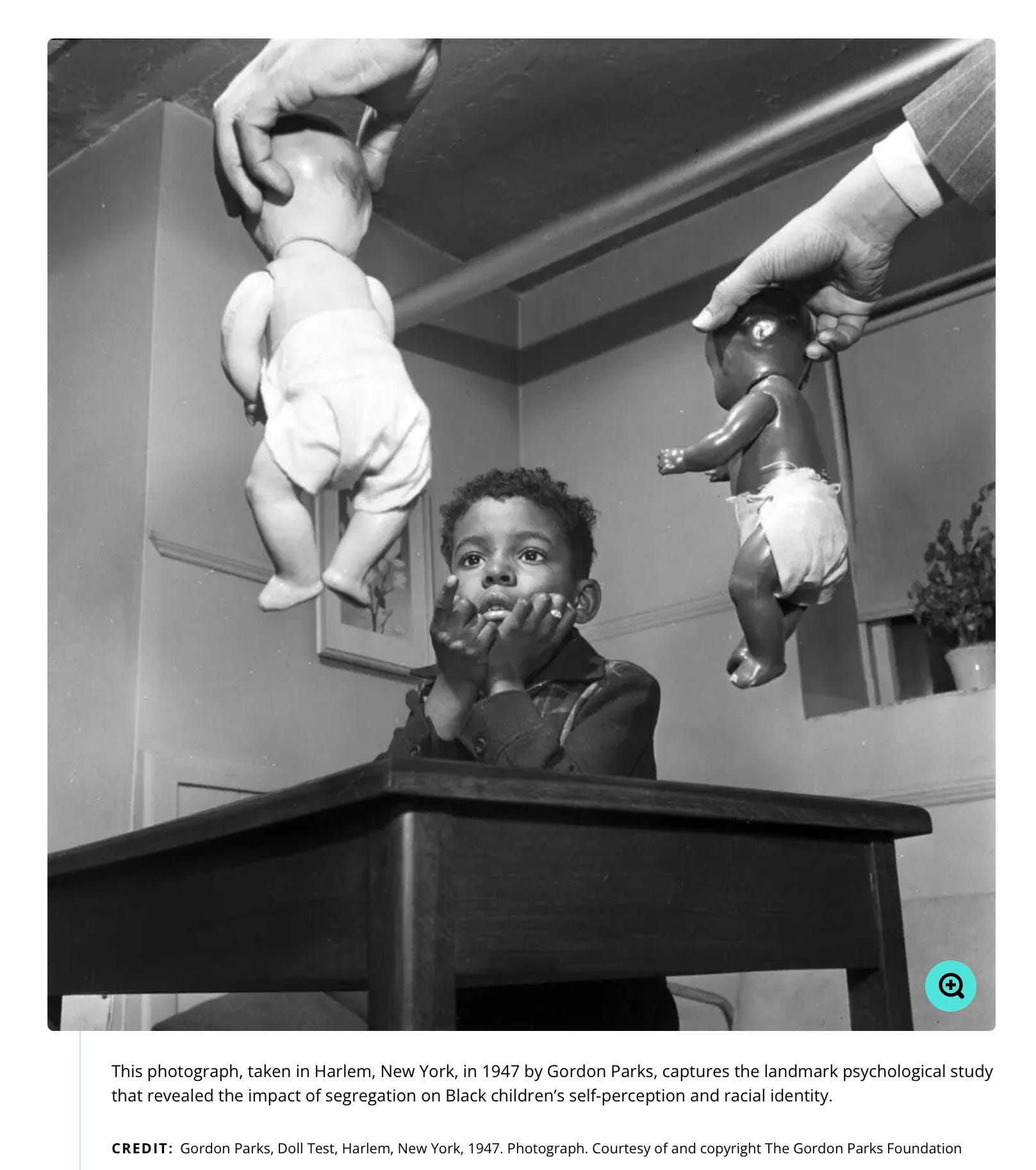
For many decades, Barbie (and later Ken) was very thin and very white. In 1949/50, two psychologists published the results of their now famous “doll study” of internalized racial attitudes in black children (KB Clark and MP Clark, Emotional Factors in Racial Identification and Preference in Negro Children, The Journal of Negro Education, Vol. 19, No. 3, 1950).
In a free play interview, a majority (~2/3) of the black children preferred a white doll and attributed positive characteristics to it, while attributing negative characteristics to a black doll.
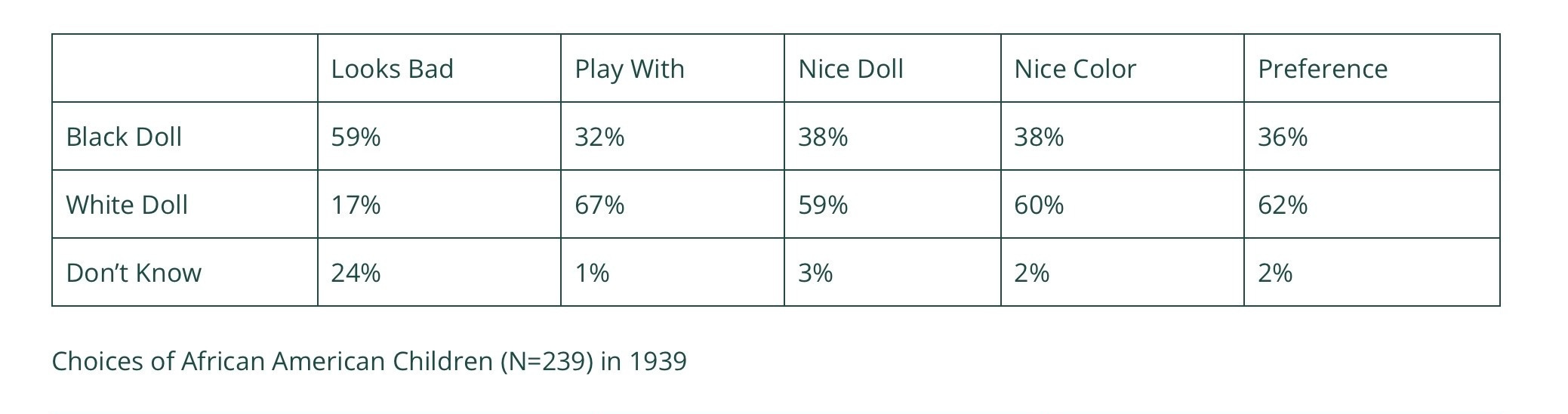
The Clarks concluded that prejudice, discrimination and segregation caused black children to develop a sense of inferiority and self-hatred.
A majority of these children disturbingly rejected the black or brown doll, and [ascribed] positive characteristics to the white doll—not all, but the majority did. Then the most disturbing question, and one that really made me, even as a scientist, upset, was we then asked as the final question, “Now show me the doll that’s most like you.” And it was disturbing because many of the children were emotionally upset at having to identify with the doll that they had rejected. Some of them would walk out the room or refuse to answer that question. And this we interpreted as indicating that color, in a racist society, was a very disturbing and traumatic component of an individual’s sense of his own self esteem and worth. … These children saw themselves as inferior …
Segregation is a way in which a society tells a group of human beings that they are inferior to other groups of human beings. … When a whole society is organized to … reinforce the inferior status of these individuals, it lowers their self-esteem. It makes them feel that they’re not as worthy as the non-segregated groups of human beings, and this continues pretty much through the rest of their lives.
— Interview with Dr. Kenneth Clark, Eyes on the Prize: America's Civil Rights Years (1954–1965), Blackside, Inc., November 4, 1985
The Clarks noted in their journal article that “If society says it is better to be White, not only White people but Negroes come to believe it. And a child may try to escape the trap of inferiority by denying the fact of (their) own race.”
This is a case of traumatic accommodation to and internalization of a toxic self-stereotype. Is it too great a leap to assume that the same dynamics will apply in a society that says it is better to be male? To be Christ-ian? To have a college degree? To be rich? To be ‘beautiful’?
Liberation and solidarity
Solidarnosc (Solidarity): The labor union largely responsible for the fall of the communist government in Poland in the early 1980’s
When a person is told by their culture that they are Not Good, they can fight against that message and its architects, submit to them, or head for the border. Those who accommodate and change their self-image to conform to the dominant negative stereotypes will be freed from the stress and struggle for equality and opportunity, but remain imprisoned in a cycle of self-hate and a reduced quality of life.
This is why the first battles in wars of liberation must be fought out on the field of the Self.
The American civil rights movement was fueled by mantras like “Black is beautiful” to provide an antidote to toxic cultural messages. Hair that was devalued as ‘ugly’ by the dominant white culture (and defensively straightened with toxic chemicals which were also applied to lighten ‘dark’ skin) was grown out as a loud and proud afro. Cultural references to a majority black African history/culture adorned black bodies with native clothes and jewelry. Embracing the cultural heritage and accomplishments of black scientists and musicians and politicians and athletes and writers served as powerful weapons in the crusade against the message of inferiority.
At its heart, feminism is simply about the pursuit of equality of status and opportunity for women and men. In the early stages of the US women’s movement, cultural pressures to conform to rigid and limiting role parameters were recognized and called out as harmful. Women fought hard to reclaim their bodies and souls from a restrictive cult of femininity, and advocated for equal pay and access to all careers and positions of status and power. Profiles of successful women in all fields and walks of life were rescued from centuries of obscurity and held up as inspiring models, especially for young girls dreaming about their future selves and lives.
One of the biggest obstacles to successful liberation movements (rebelling against oppression by reason of class, ethnicity, sex, ‘race’ etc.) is a lack of SOLIDARITY within their own ranks. When those who submit and accommodate to the dominant negative stereotypes also attack and undermine those engaged in the hard battle for equality and opportunity, they drain off vital energy from the main project. They also provide aid and comfort to the elites and their project of divide and conquer.
During the German occupation of France during WWII, the organized resistance was undermined repeatedly by the collaborators in the Vichy government and in the general population. Women seeking equality of status and opportunity are often undermined by other women who seek to enforce certain standards of femininity around issues such as work, money, sex, child rearing and family decision-making/power.
When Martin Luther King was imprisoned during his leadership of the boycott of the Birmingham Alabama (USA) bus system, he gave vent to his anger and frustration with the bourgeois blacks who were managing to gain some advantages within the apartheid system in the US. In his now justly famous Letter from a Birmingham Jail (1963), King responded to the criticism from certain black elites that the civil rights movement was too disruptive in its tactics and pushing too hard and too fast for change:
We know through painful experience that freedom is never voluntarily given by the oppressor; it must be demanded by the oppressed. Frankly, I have yet to engage in a direct action campaign that was “well timed” in the view of those who have not suffered unduly from the disease of segregation. For years now I have heard the word “Wait!” It rings in the ear of every Negro with piercing familiarity. This “Wait” has almost always meant “Never.” We must come to see, with one of our distinguished jurists, that “justice too long delayed is justice denied.”
The full letter is available here and deserves to be read in its entirety as a case example of how to respond to the oft-repeated refrain from powerful elites that oppressed people are unreasonable in their demands for freedom and justice.
Conclusion
Is the system going to flatten you out and deny you your humanity, or are you going to be able to make use of the system to the attainment of human purposes? — Joseph Campbell
The founding document of the United States of America is a Declaration of INDEPENDENCE from unelected authority.. It declares that each person is endowed with certain rights such as life, LIBERTY and the pursuit of happiness. The US Pledge of Allegiance ends with the words “with LIBERTY and JUSTICE for all.”
When we think of independence and freedom, we often conceive of it in physical/spatial terms as one body being free of entanglement with and limitations imposed by another body. There is another form of oppression that can deny a person their freedom and humanity, and that is one that attempts to coerce a person into believing that they are not worthy of inclusion within the sphere where those unalienable rights apply. This involves a system that seeks to create a mental prison and bondage by convincing a class of people that they are not Good, not Worthy, not Valuable, not fully … Human.
This is a cultural system of belief and action whose primary aim is to convince a person that they are an IT rather than a THOU. When a living being (human and otherwise) is viewed as a THING, they become food for the master’s appetite. They can be consumed ruth-lessly (without guilt). The reduction of a being to a thing is the foundational mindset of every violation of human rights, every violent attack, every murder, every genocide/ecocide.
If a ruling elite can manage to convince a class of people to hate themselves and to believe that they are not deserving of life, liberty and the pursuit of happiness, it becomes much easier to dominate and abuse them without limit. Such a project of mental debasement and dehumanization, wherever it appears and whoever it targets, must be fought by all means available by all willing souls.
A defining moment in my life was when I realized that the (US) declaration of independence really didn't apply to me. It solidified my resistance and desire for a replacement culture/community.
I deem this post as Good! (Actually outstanding but wanted to use your phrasing). So good Baird.
I’ve been mulling over the question of identity lately and the foundations of it. At its core, I find simply identifying oneself as a human being to be the most productive for what you write on here. Under human being, we can then get into the unique roles one has and defined whys or prioritized how one exhibits said identity.
Thanks for another great piece